Navajoland Bishop Search
Candidate: Rev. Cornelia Eaton
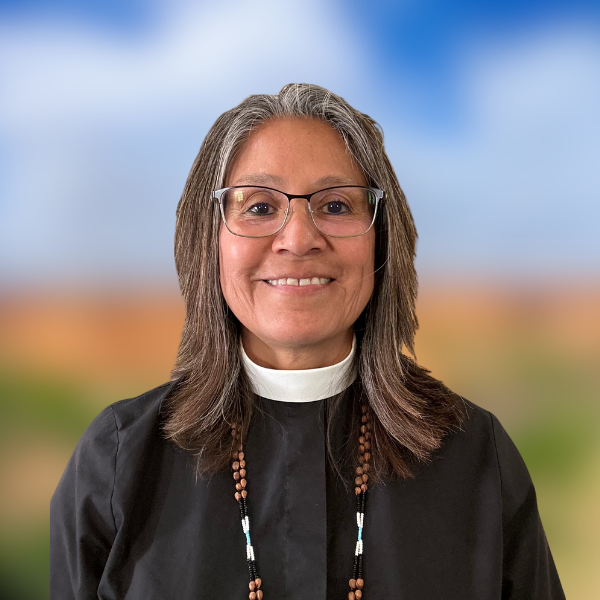
The Rev. Cornelia Eaton
Canon to the Ordinary- The Missionary Diocese of Navajoland
The Rev. Canon Cornelia Eaton, raised in Upper Fruitland, New Mexico, is a member of the Diné Navajo Tribe. Born to Alice Mason and the late Deacon Yazzie Mason, her maternal clan is Ashįįhí, Salt Clan; her paternal clan is Hashtł’ishnii, Mud Clan; her paternal grandfather’s clan is Nakai Dine’é, Mexican Clan; and her maternal grandfather’s clan is, Tłááshchí’i, Red Bottom Clan.
With strong ties to St. Michael’s Church and her family’s farm and sheep camp, Cornelia was raised in Diné culture and the Episcopal tradition. Her faith and practice are rooted in Diné ancestral perspectives and Anglican Communion theology. Cornelia was ordained a deacon in the Episcopal Church in Navajoland (ECN) in 2013 and a priest in 2015. Over the decades, she served on many committees and councils of The Episcopal Church and received her Master of Divinity degree at Virginia Theological Seminary. Her leadership roles have taken her around the country and overseas, from New York to New Zealand, Philadelphia to the Philippines, and Washington D.C. to Jerusalem.
Presently, Cornelia serves as the Canon to the Ordinary in Navajoland and is the program director for the Hozhó Beauty Way Center in ECN. Dedicated to serving the people of Navajoland, Cornelia shares God’s love, hope, healing and reconciliation through the teachings of the Good News and Diné spirituality on Hozhó. Cornelia has published articles, stories, prayers, and poetry on the Beauty Way, particularly íina biké hozhó—encouraging others to live in balance and relationship with divine creation. She enjoys mountain biking, hiking, fly-fishing, raising sheep, listening to music, reading, and spending time with her beloved granddaughter, Allison. Cornelia is a proud mother to Nicole and a sister, aunt, and relative to many throughout the world.
Answers to Essay Questions:
In light of the ECN Mission Statement, how would you propose to help the congregations and people of Navajoland to live into this statement?
I recognize that our mission statement is a prayer. This beautiful prayer identifies who we are and is uttered to God in our worship services and in many of our gatherings. I would propose that the diocese as a whole take a deep dive into this sacred prayer and unpack it carefully like a sacred medicine bundle, just as Jesus unpacked the sacred scroll of Isaiah 61:1-2 in the synagogue in Nazareth (Luke 4:16-21). The word of the prophet Isaiah was the mission prayer for Jesus’ ministry. I would encourage the Missionary Diocese of Navajoland to discern how our prayer is calling us to action, to do justice, love mercy, and walk humbly with God (Micah 6: 8). I would seek to bring a centering focus to this work through the themes: The Way, Ké, Service, and Healing. I would then propose that each congregation or region pray about how the Holy Spirit is calling us to do ministry in recognizing the needs of their faith communities, and address how they are called to meet those needs in a practical approach while staying focus on guiding principle of the mission of Navajoland. I believe this pathway will bring clarity and passion to our faith community as we walk in path of the Beauty Way as disciples of Christ.
What draws you and interests you in becoming Bishop of Navajoland?
What draws me to becoming bishop of Navajoland is the calling of the Holy Spirit. This call frightens me, yet my trust in God’s grace leads me to step forward into the role of the episcopate. I have felt a call to a wider leadership in the Church early in my life, but was uncertain what all this meant. I witnessed my parents and elders modestly speak truth and seek justice and have watched how they faithfully they followed the way of Jesus. I have offered my best efforts to model their leadership in my own life. My interest is to continue to serve and guide the people of this diocese and build up the Body of Christ, and prepare the way for our future in our changing world, in which our communities yearn for hope and faith. I am interested in how God will show us to plant the seeds of healing and reconciliation for the sake of relationships, not just within the four sacred mountains but throughout the world. Ministering to God’s people is challenging and as bishop I am interested in the challenge and listen to what God is up to and how the Holy Spirit is speaking to the people of this diocese about how we approach these times. I am interested in learning to be the bishop that God and the people of this diocese need in this time, and I will be devoted to shepherding us in the direction God is calling us.
As indigenous Christians, we faithfully follow Jesus while also honoring our cultural traditions within the life of the church. If a parishioner resists embracing this dual identity, how would you provide guidance and ensure Diné culture is respected in the Body of Christ?
The two goals of honoring our culture and our God can be challenging to achieve. I understand this and would deeply listen to the parishioner who is struggling with the faith and learn more about this person’s upbringing. I would share my personal experiences as a young adult, when I resisted this dual identity between Christianity and Diné religion, when I struggled with how the right way to pray for salvation, and how I came to a fuller understanding of how culture and faith can connect. I learned that God never asked Jesus of Nazareth to stop being Jewish. Jesus practiced his culture and traditions that were rich in rituals and prayers. What matters, in being Christian and Diné, is that we remain faithful, loving God and loving our neighbors as ourselves, and honoring the traditions of the faith of Hozhójíí, that were long practiced since the time of divine creation. I would share that how open-mindedness offers a way to relationship between faith and traditions, and that God is present in both faith and traditions. It is important to set healthy boundaries and to be clear that we are a church that embrace Diné tradition, culture, and spirituality that enrich our relationship with God and peoples. Finding the connections between these two identities is part of our unique journey of faith as Diné Christians.
This diocese serves a community impacted by intergenerational trauma, with associated challenges including substance use and mental health struggles. The clergy are called to offer compassionate, trauma-informed care and spiritual support.
What experiences have shaped your understanding of addiction and recovery, and how would you, as bishop, promote long-term recovery and support for those struggling with alcohol and drug use disorder in Navajoland? What personal commitments or values guide your approach?
As a recovering alcoholic and practicing member of Alcoholics Anonymous, I understand the challenges and struggles of the disease of alcoholism. I have had my own battle with the disease and of understanding how it is a result of intergenerational grief trauma. Sobriety is a gift and how I use my gift to carry the message to those struggling with the disease that there is hope to wholeness, wellness, and healing, and that we are worthy of God’s love. This is how a spiritual awakening is experienced through helping another. Alcoholism, drug addiction, and many other addictions represent a spiritual illness that harms the mind, body and soul of one struggling with them. While there is no “cure” it is possible to stop through a desire to completely give of self to the care of God or one’s own understanding of the divine Higher Power. Addiction to alcohol and drugs and other substances, as well as the challenges of dealing with mental illness need to be recognized as medical conditions to which resources, those of the church and government, need to be directed. I would be passionately active in encouraging awareness through ongoing education, and encourage treatment programs and providing safe and brave places for recovery meetings in each of the regions. Presently I serve as the director of Hozhó Beauty Way Wellness Center and as bishop I will continue to make recovery ministries a priority in the diocese and in the wider Church.