
Navajoland Bishop Search
Candidate: Rev. Alyssa Stebbing
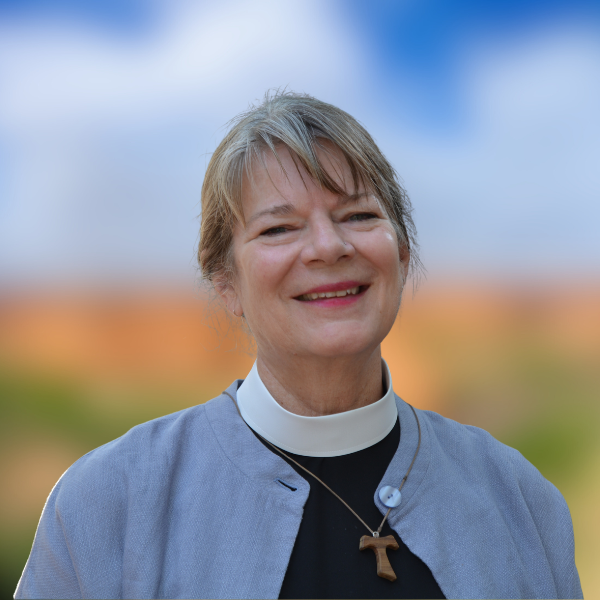
The Rev. Alyssa Stebbing
Rector of St. Christopher’s Episcopal Church, Austin- The Episcopal Diocese of Texas
The Rev. Alyssa Stebbing currently serves as Rector of St. Christopher’s Epsicopal Church in Austin, TX. She lives in South Austin with her husband, Colin, and her mother. Between Alyssa and Colin, they have seven adult children and six grandchildren spanning from Alaska to England.
While she was born in Texas, almost all of her childhood and adulthood was spent in New Mexico and Colorado, at times in areas so remote the school bus could not get to her house. She went to school with other children from Mexico, Central America, and Dinétah. She was introduced to God from the understanding of these cultures before her family began attending a Christian church in New Mexico when she was 12 years old.
Since 1989, Alyssa has served in a variety of ministries that support those in poverty, fleeing violence, refugee resettlement, and in migration ministries. She worked for nine years with Compassion International around the world and on reservations raising funds for education, food insecurity, and medical needs of children. As a professed Franciscan with the Order of Ecumenical Franciscans, her call is to walk with the poor and marginalized, respecting the dignity of every human being. For her, this has been walking The Beauty Way that shaped her as a child, finding harmony and balance and the presence of God in all circumstances.
A lifelong artist and musician, in 1997, she helped form The Legacy Ministry (aka The Legacy of a Kid Brother of St. Frank) which worked with youth on Native American reservations, using the healing of the Spirit through music and the arts to help youth experiencing trauma. The Legacy also led spiritual formation retreats around the country. The Legacy was invited to take the program to youth in Guatemala, Russia, and Canada, as well as other demographics within the United States. The program ran for nine years after which she was hired by Trinity Epsicopal Church in the Woodlands, TX to develop a liturgical contemporary music program and outreach ministry for a church which had undergone a split. She was on the ministry staff for thirteen years. During that time, she was invited to Standing Rock and Spirit Lake reservations in North Dakota and created a reciprocal model of mission between the Episcopal Church on Spirit Lake reservation and Trinity Episcopal Church.
She completed a Master of Divinity at the Seminary of the Southwest in Austin, Texas and served for two years at St. Paul San Pablo Episcopal Church in Houston, Texas. Alyssa has served on the Board of Lord of the Streets in Houston and twice as an Anglican delegate to the UN Commission on the Status of Women. She currently serves on the Board of El Buen Samaritano in Austin, TX and as an Episcopal Migration Ministries Liaison for the Diocese of Texas.
She is humbled and honored to participate with other wonderful candidates to discern and pray for the new Bishop of the Missionary Diocese of Navajoland.
Answers to Essay Questions:
In light of the ECN Mission Statement, how would you propose to help the congregations and people of Navajoland to live into this statement?
From what I have learned from the Dine, The Beauty (Blessing) Way is the path of harmony, wholeness, compassion, and love. Restoration is the goal. It is accomplished by walking together and honoring each other, service, giving and seeking forgiveness, and building trusting relationships.
What draws you and interests you in becoming Bishop of Navajoland?
The Diné helped shape my theology of God & a spiritual connection to the land & all created things. I have deep respect for what the Diné have to offer to bring wholeness to the church in Navajoland and all of TEC. I see so much potential for ECN to flourish and become a strong unified presence of God’s love.
As indigenous Christians, we faithfully follow Jesus while also honoring our cultural traditions within the life of the church. If a parishioner resists embracing this dual identity, how would you provide guidance and ensure Diné culture is respected in the Body of Christ?
First to understand the resistance–is it linked to old missionary teachings, how they read the Bible, or some other theological or cultural fear? It might be possible to host a study group unless parishioner is afraid to ask those questions in a group. 1:1 mentoring may also be needed.
This diocese serves a community impacted by intergenerational trauma, with associated challenges including substance use and mental health struggles. The clergy are called to offer compassionate, trauma-informed care and spiritual support.
What experiences have shaped your understanding of addiction and recovery, and how would you, as bishop, promote long-term recovery and support for those struggling with alcohol and drug use disorder in Navajoland? What personal commitments or values guide your approach?
I have personal experience in my family with trauma, addiction, & substance abuse. Some are in recovery, and one member died of an overdose. I have worked with women in domestic violence and am deeply committed to the recovery community & seek to address the shame that often inhibits recovery.