Navajoland Bishop Search
Candidate: Rev. Leon Sampson
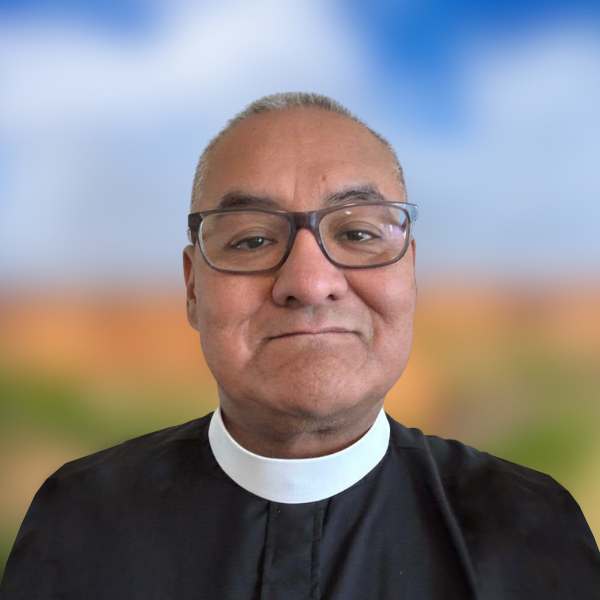
The Rev. Leon Sampson
Co- Vicar of the Southeast Region- The Missionary Diocese of Navajoland
Answers to Essay Questions:
In light of the ECN Mission Statement, how would you propose to help the congregations and people of Navajoland to live into this statement?
Navajoland Area Mission was established when the Diné people desired to gather together as a community of faith. Over the years, the Episcopal Church Missionaries have walked with the people, praying and preaching the Gospel, and even raised those who felt called to lay leadership. The Diné have always had a belief system that includes Dyin’, or Creator, and through the practice of living the Gospel, we naturally treat each other and our neighbors with love. The way families teach their children about how to live, be resilient, and respect the Ke’ Clan with the community is what I was raised with, just like many of our church members.
The universal belief shared between the Dine’ spirituality and Episcopal Anglican beliefs is the recognition of the “Dyin”, the Creator; therefore, I believe the Dine’ people already live into the Mission Statement, and it is our call as Diné-Episcopalian clergy to rekindle that fire under the core principles of walking the Pollen Pathway, and have hope and faith to know that this is still God’s call for us to offer healing through welcoming all to live into the mission statement, or the beauty way.
What draws you and interests you in becoming Bishop of Navajoland?
I was raised as a “Cradleboard” Episcopalian, set in a Navajo cradleboard and propped up in the pews of the church services. All of my childhood memories are centered around the church and involve the church’s work. I never realized how important it was to have a church family to love and support each other until I entered adulthood and was removed from my church family. It wasn’t until I had gone through the challenges of life and come home to the very community that raised me. When I returned home a broken person, caught up in Alcoholism, I was ashamed to set foot back into the church doors. Without hesitation, the congregation welcomed me with hugs, saying, “We don’t care what you did, you’re home now”. The feeling of forgiveness made me curious to explore the reasons why they could forgive me so easily; that transformation led me to yearn for a deeper, more meaningful understanding of God, one that would guide me and give my life purpose. In that moment of transformation, it was then that God came to me and healed me.
During my call to the Diaconate, I served as an outreach manager for the Homer Dale community gardening program. During this time of discernment, I was blessed to witness our elder community members utilize the garden space to teach their children, grandchildren, and great-grandchildren the practices of humility towards creation through respect, prayer, and giving thanks for an abundant harvest. The most powerful witnessing of these types of individual transformations is when I reconnect with these families and see that they are still living a life of prayer and giving thanks.
Throughout my call to serve in my ministry with the Diné communities, I observe our people walking in different phases of life, some who have chosen the same path as I have, some who are seeking answers and guidance, and I offer them a way to know love, love from God. When that love is received from God, I see the same transformation that I was blessed to witness, and I see that same transformation in myself.
I pray every day for our churches, and for the people to feel these types of connections with God and with our neighbors, so much so that we could be the church that welcomes people back home. As a bishop of Navajoland, I feel that our core values, as outlined in the pollen pathway, have been somewhat diluted by the social challenges and influences of our world today. I invite us to have a jubilee and revive our love for Hozho’ and walk together.
As indigenous Christians, we faithfully follow Jesus while also honoring our cultural traditions within the life of the church. If a parishioner resists embracing this dual identity, how would you provide guidance and ensure Diné culture is respected in the Body of Christ?
I have been blessed to participate in many Episcopal and non-Episcopal programs with Indigenous communities. One universal story I have heard is the story of being introduced to a European Church faith and living in a way that reflects the traditions of their Indigenous families. I know exactly what they are testifying to because I was raised in the same dual faith belief system, and for my younger years, I struggled to decide which faith to believe in. My father taught me the gift of prayer as an indigenous, early in the morning, towards the East, and in that early morning, I found God to be in my heart, both as one. Before this moment, I was lost and was ashamed of being a part of two faiths that divided my spirituality. Through understanding that God/Creator is the same, I experienced a healing moment that gave me mercy and forgiveness, and I felt called to serve my community.
I genuinely believe our Indigenous communities are struggling with the same spiritual warfare, and these divisions have a profound adverse effect on how we live into a life of the Beauty Way. The Episcopal Church features a bumper sticker logo that reads, “All Are Welcome.” This means a lot to me when I see local community members who come to the church, having been shamed away from one belief or the other because they are conflicted about where their faith lies.
I believe the mission statement that was developed is a true gift, offering a way to heal and know God through who we truly are as indigenous people. “In the name of Jesus Christ, the Holy One, we seek forgiveness and wholeness”.
This diocese serves a community impacted by intergenerational trauma, with associated challenges including substance use and mental health struggles. The clergy are called to offer compassionate, trauma-informed care and spiritual support.
What experiences have shaped your understanding of addiction and recovery, and how would you, as bishop, promote long-term recovery and support for those struggling with alcohol and drug use disorder in Navajoland? What personal commitments or values guide your approach?
I was raised in a household that struggled with Alcohol addiction. My father and grandfather introduced it into our household. This started to influence how my brothers and sisters engage in social interactions with their peers in their adolescent years. Eventually, I was introduced to alcohol by my cousins, and that created a culture of dependence on alcohol throughout my life. On August 14, 2010, my wife, Madeline, and I took a trip to Fort Hall, ID, for the Shone Bannock Festival and Pow Wow. I was never really into Pow Wow, but I was able to experience the pride of an indigenous community that celebrated their identity and culture without addiction. I felt the power of the pow wow drum. That day, I offered tobacco to the drum and asked for sobriety. September 11th, 2010, I committed to sobriety and focused on my call to serve God. Every year, I request time off from work to travel back to the festival to remind me of the power of realizing how alcohol has suppressed my life, and to keep striving to stay sober.
On August 4, 2016, I accepted a call to attend Virginia Theological Seminary, starting the semester with Safe Church and Anti-Racism training. This experience was something I had never had before: living in a community away from home and feeling out of place. What I realized was that seminary, for me, was going to be a big challenge as a recovering alcoholic. I relapsed and was feeling shame and guilt, until I attended a student council meeting and introduced myself. I guess, somewhere during that time, I mentioned I was a recovering alcoholic. Soon after, I started to attract other recovering alcoholics, and we wrote a resolution that would ask that when any seminary social events would take place, the event would also offer equally attractive non-alcoholic drinks. I also found an AA support meeting group called “Tools for Sobriety”.
Today, as I serve a community that struggles with addiction, I have collaborated with local AA groups to offer meeting spaces in our buildings for them to have AA group meetings. R4Thursday AA meetings started meeting every Thursday from 6:00 pm to 7:30 pm; now, they meet three times a week and are well attended.
As a recovering priest in a community that struggles with alcohol, I feel my story and experiences can help those who are seeking a better life in recovery. All our churches have the building space and resources to support recovery programs to build a program that offers hope to those who are seeking help.