K’é Bee Hózhó: Beauty Through Relationship
By: GJ Gordy
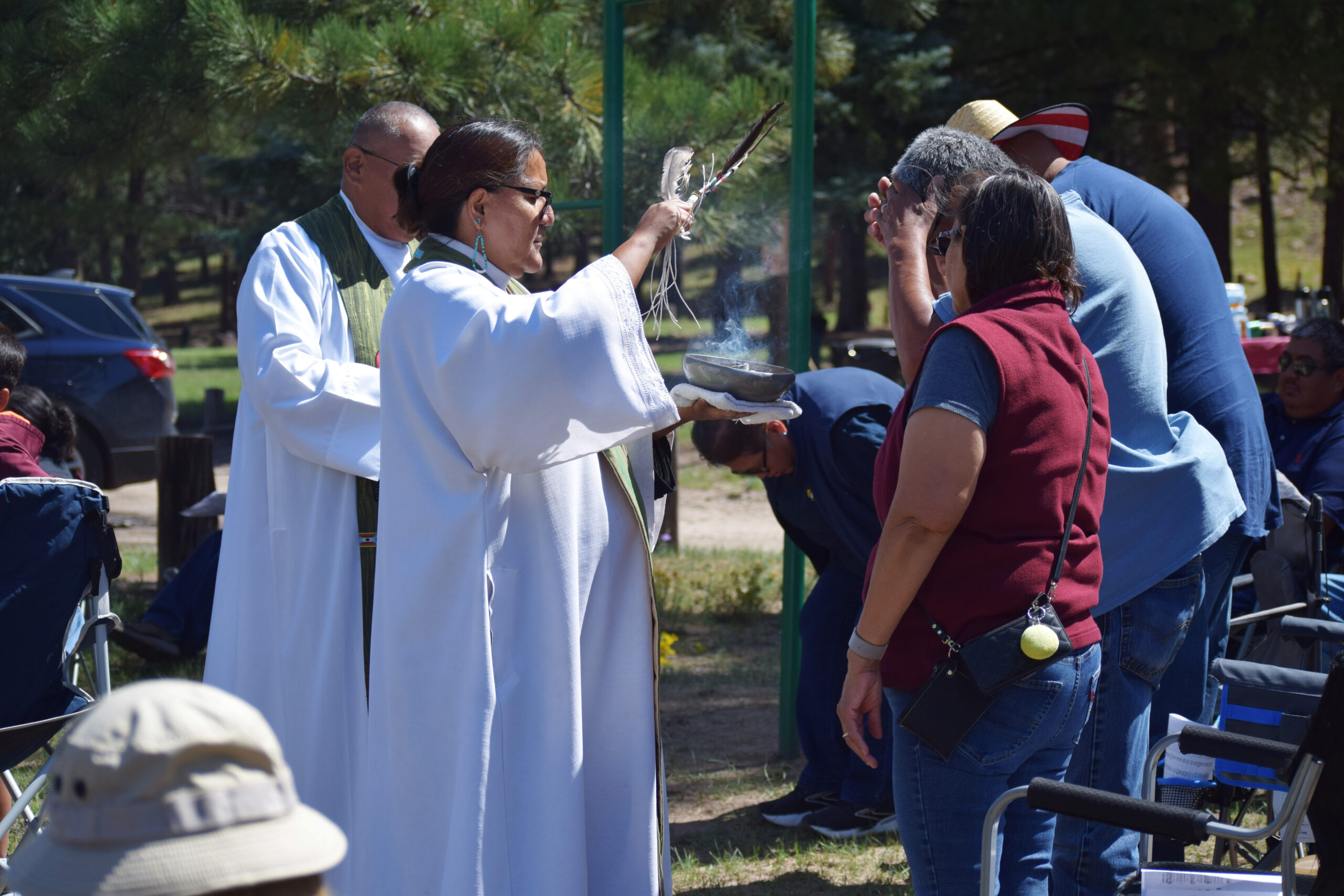
Standing in the heart of the Chuska Mountains, our congregations come together to offer prayers and blessings for creation and life. Gathered facing east toward the morning sun, people open their hands to receive the blessing of cedar smoke as Navajo clergy make their way around the congregation with eagle feathers. Before us, a table is set with bread and non-al-coholic wine that we will soon share together. It is a moment that holds our Diné ways, our Christian faith, and our life together as a community.
K’é is often translated into English as kinship or relationship, but those words alone cannot carry everything K’é means. K’é helps us understand who we are in relationship to one another and how those relationships call us to live as Bilá ashdla’ii, or “five-fingered people.” We are human beings, and therefore we have responsibilities to one another. K’é carries respect, care, and an understanding that we do not live only for ourselves.
Hózhó, too, means more than beauty. It speaks of balance, harmony, and walking in a good way, together and individually. Together, K’é Bee Hózhó invites us to consider how beauty and balance are found and restored through right relationship with all of creation.
For us in Navajoland, these teachings are not separate from our Christian faith. They can help us understand more deeply what Jesus asks of us when he calls us to love God and love our neighbor, to forgive, to welcome, to serve, and to care for one another. We do not have to leave behind who we are as Diné people in order to follow Christ. We bring who we are into that relationship.
As the articles for this issue began arriving, I noticed something. No two writers approached the theme in quite the same way. Some wrote about family and community. Others wrote about planting, giving, listening, remembering, traveling, welcoming, healing, or walking through change. Some relationships in these pages have lasted for decades. Others began only recently. Some stretch across the Episcopal Church and even across an ocean.
Yet underneath these very different stories was the same reminder: relationship is something we practice.
It is easy to speak about relationship. It is another thing to return year after year. To listen when we would rather speak. To remember those who came before us. To make room for young people who are finding their own way. To give what we can. To receive what another person has to offer.
To remain together when the path ahead is uncertain.
Maybe this is also something Navajoland can offer to the wider Church.
So much of our world encourages us to begin with what separates us. K’é asks us to begin somewhere else. It reminds us that our lives are connected and that those connections matter. Relationship does not erase our differences. Instead, it gives us a way to walk with one another while honoring who each of us is.
That is also why relationship is more than simply knowing about another person or community. To be in relationship is to listen, to learn, to show up, and eventually to recognize that what happens to one another matters.
Throughout this issue, you will see that lived in many different ways. There is no single story here that completely explains K’é, nor should there be. Instead, these pages offer glimpses of what can happen when relationship is cared for.
Back in the Chuska Mountains, after the prayers are offered and the cedar smoke rises, we gather around the table. We receive the bread and the cup together. We came from different congregations and communities, carrying different stories, but we share in something together.
Maybe that is where beauty is found. Not only in the mountains surrounding us or the morning sun before us, but in the relationships among us and our responsibility to care for them.
K’é Bee Hózhó.
Beauty through relationship.